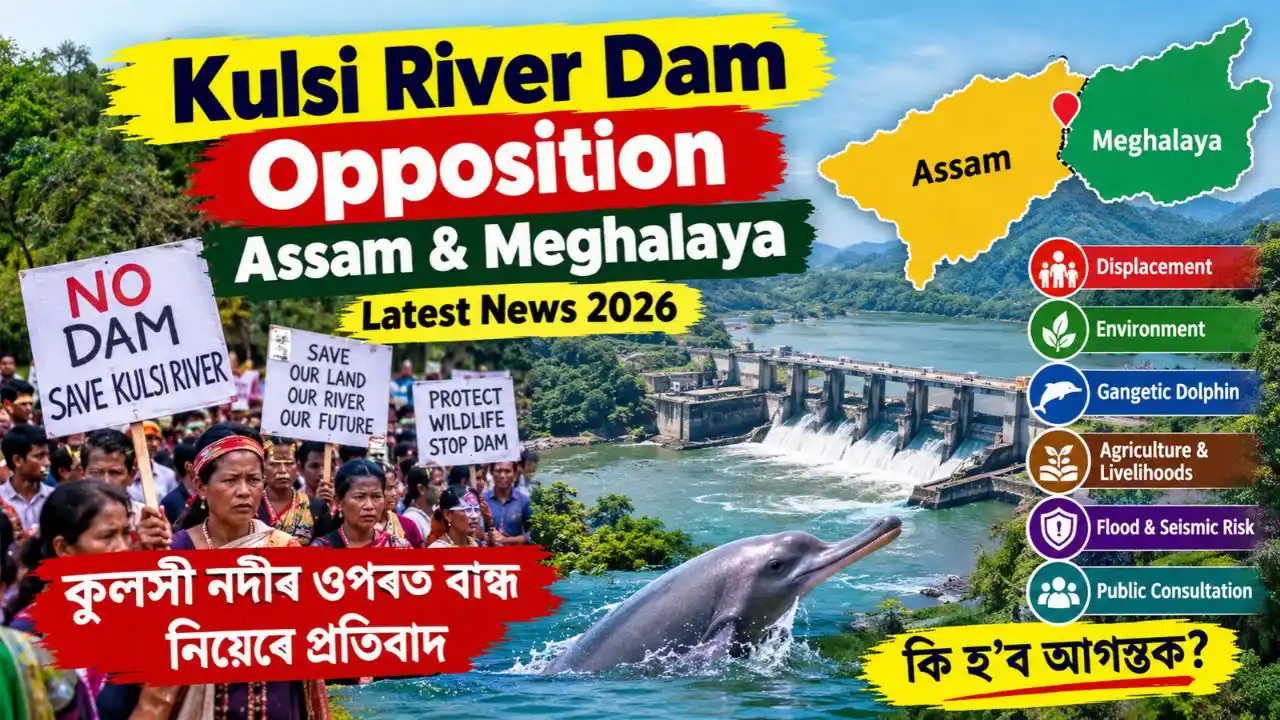
The Kulsi River Dam opposition in Assam and Meghalaya has become a major environmental and public-interest issue in Northeast India. Residents from both states are protesting against the proposed 55 MW Kulsi Multipurpose Hydropower Project, raising concerns about the displacement of local communities, environmental damage, the future of the endangered Gangetic river dolphin, and the impact on traditional livelihoods.
On October 8, 2026, more than 2,000 people from the Rabha, Bodo, Garo and Khasi communities reportedly gathered near Ukiam to oppose the proposed dam. The demonstration highlighted growing cooperation between communities living along the Assam–Meghalaya border. Traditional Khasi chiefs also expressed their opposition to the project.
The controversy has attracted attention because the project is intended to generate electricity and support irrigation, while local residents fear that its environmental and social costs could be significant.
In this article, we explain the Kulsi River Dam project, why people are opposing it, the latest protest developments, the environmental concerns, and what may happen next.
Kulsi River Dam Opposition: Latest News 2026
The opposition to the proposed Kulsi River Dam has intensified during 2026. Local organisations and residents have continued to demand the cancellation of the project, arguing that their concerns about land, livelihoods and the environment must be addressed before any construction proceeds.
On July 30, 2026, the Brahmaputra Board formally handed over the Detailed Project Report (DPR) and associated project documents to the Assam Power Generation Corporation Limited (APGCL). This development enabled the Assam government to take forward the project’s implementation process. The announcement was made by the Ministry of Jal Shakti.
However, the transfer of the DPR was followed by renewed protests. In August 2026, residents gathered at Ukiam and other locations to oppose the proposed dam. The movement gained further attention in October when thousands of people from communities in both Assam and Meghalaya participated in a joint protest.
The key issue is whether the proposed project’s electricity and irrigation benefits justify the potential social and environmental impacts.
Kulsi River Dam Project: Overview
The Kulsi Multipurpose Project is a proposed hydropower and irrigation project on the Kulsi River, along the Assam–Meghalaya border. The project is intended to generate electricity and provide irrigation benefits to agricultural areas.
According to the Ministry of Jal Shakti, the project has a proposed installed hydropower capacity of 55 MW and an irrigation command area of approximately 26,000 hectares. Its estimated cost is ₹1,454.95 crore at the June 2017 price level.
| Project detail | Information |
|---|---|
| Project name | Kulsi Multipurpose Project |
| River | Kulsi River |
| Location | Assam–Meghalaya border |
| Proposed power capacity | 55 MW |
| Main purposes | Hydropower generation and irrigation |
| Proposed irrigation command area | Approximately 26,000 hectares |
| Estimated project cost | ₹1,454.95 crore at June 2017 price level |
| Project report prepared by | Brahmaputra Board |
| Project documents transferred to | Assam Power Generation Corporation Limited (APGCL) |
| Major opposition | Local residents, tribal communities and environmental groups |
| Main concerns | Displacement, biodiversity, livelihoods and river ecology |
Where Is the Kulsi River?
The Kulsi River is an important river system associated with Meghalaya’s hill streams and the plains of Assam. The river flows through areas near the inter-state border and supports local communities, agriculture, fisheries and riverine biodiversity.
Ukiam is one of the locations associated with the proposed dam and the ongoing protests. The area lies near communities whose livelihoods are closely connected to the river and surrounding land.
The Kulsi River is also known for its Gangetic river dolphin population. This makes the proposed project particularly significant from a conservation perspective.
For people living near the river, it is more than a source of water. It is connected to farming, fishing, local traditions, natural resources and the economic activities of surrounding villages.
Why Are People Opposing the Kulsi River Dam?
Several organisations and residents from Assam and Meghalaya have raised objections to the proposed project. Their concerns include the following issues.
1. Fear of Displacement of Local Communities
One of the biggest concerns is the potential displacement of residents living near the proposed project area.
Construction of a major dam and its associated infrastructure may require land for the reservoir, access roads and other facilities. Depending on the final design and affected area, some households could face relocation or restrictions on their existing land use.
Residents fear that displacement could affect their homes, agricultural land, community networks and traditional ways of life.
Before any such project proceeds, affected households need clear information about land acquisition, rehabilitation, compensation and alternative livelihood arrangements.
2. Environmental Damage and Loss of Biodiversity
Environmental protection is another major reason for the opposition.
Large hydropower projects can change river flow, sediment movement, fish habitats and the natural characteristics of surrounding areas. The extent of these impacts depends on the design, construction methods, reservoir size and operating rules.
People opposing the Kulsi project fear that changes to the river could affect aquatic life, wetlands, forests and nearby agricultural ecosystems.
Environmental groups have therefore called for careful impact assessments and stronger protection measures before decisions are made.
3. Threat to the Endangered Gangetic River Dolphin
The Gangetic river dolphin is one of the most important wildlife concerns associated with the Kulsi River Dam controversy.
The river is reported to support this endangered freshwater species. Changes in water flow, habitat connectivity, underwater conditions and food availability could affect the species.
A detailed ecological assessment should establish the dolphin population’s distribution, critical habitats, seasonal movements and the potential effects of construction and dam operation.
Any project approval should consider scientifically supported measures to protect the river dolphin and the broader aquatic ecosystem.
4. Concerns About Agriculture and Livelihoods
Many families in the surrounding areas depend on agriculture, fishing and other natural-resource-based activities.
The project is designed to provide irrigation benefits, but opponents are concerned that some communities could lose agricultural land or access to river resources.
The benefits and costs may also be distributed differently. Farmers receiving irrigation benefits might not be the same households that face displacement or other local impacts.
A transparent assessment should therefore explain which areas would receive irrigation, which communities could be affected and how the project would protect existing livelihoods.
5. Flood Safety and Seismic Risks
Residents have also expressed concerns about flooding and the safety of a large structure in a seismically active region.
Dam construction does not automatically increase every type of flood risk. However, reservoir operations, extreme rainfall, emergency releases and structural safety are important factors that require careful investigation.
The project’s safety assessment should examine extreme weather, earthquake loading, downstream settlements, emergency warning systems and dam-break scenarios.
Clear information about these risks is necessary for communities living both upstream and downstream.
6. Demand for Public Consultation
Another important issue is whether local communities feel adequately informed and consulted.
Residents and organisations opposing the project have demanded that their concerns be taken seriously before the government moves ahead.
For a project affecting multiple communities across a state boundary, consultation should provide understandable information about the project design, land requirements, environmental impacts, compensation and long-term benefits.
Public participation can help identify local risks that may not be fully captured by technical reports alone.
October 2026 Protest: Assam and Meghalaya Communities Unite
The October 8, 2026, protest was a significant development in the Kulsi River Dam controversy.
According to reports, more than 2,000 people from the Rabha, Bodo, Garo and Khasi communities assembled near Ukiam to oppose the project. The Assam–Meghalaya Joint Protection Committee coordinated the demonstration.
The protest was notable because people from communities on both sides of the state border came together over a shared concern.
Traditional Khasi chiefs also participated in the opposition. Reports published on October 9 stated that three chiefs had declared their intention to withhold no-objection certificates for the proposed project.
Their position adds an important customary-governance dimension to the controversy. The precise legal requirements for consent and clearances must, however, be determined under the applicable laws and the status of the affected land.
The demonstrators called for the project to be scrapped and emphasised the need to protect local communities, the river and the surrounding environment.
What Is the Government’s Position on the Kulsi Project?
The proposed project is intended to deliver hydropower generation and irrigation benefits. According to the Ministry of Jal Shakti, its planned capacity is 55 MW, and its irrigation command area is approximately 26,000 hectares.
The formal handover of the DPR to APGCL on July 30, 2026, was an important administrative development in taking the project forward.
However, a transfer of project documents does not by itself establish that every construction-related approval has been granted or that construction has been completed.
The project must be understood in the context of its applicable technical, environmental, land-related and statutory requirements.
The central policy challenge is to balance development objectives with the protection of local communities and natural ecosystems. The government will need to explain how the project can address public concerns, if it is to proceed.
Kulsi River Dam: Expected Benefits and Main Concerns
The debate involves potential benefits as well as possible costs. A balanced assessment should consider both.
| Potential benefits of the proposed project | Concerns raised by opponents |
|---|---|
| Generation of 55 MW of hydropower | Possible impacts on river ecology |
| Irrigation for an estimated 26,000 hectares | Potential loss of land and displacement |
| Support for agricultural water needs | Possible effects on existing livelihoods |
| Incidental flood-management benefits, as described in the DPR | Questions about flood safety and reservoir operations |
| Infrastructure and related economic activity | Concerns about community consultation |
| Additional electricity supply | Potential impacts on the Gangetic river dolphin |
These benefits are project objectives rather than guarantees of outcomes. Their actual value will depend on implementation, while the extent of environmental and social impacts must be established through appropriate assessments.
How Could the Kulsi Dam Affect Assam–Meghalaya Relations?
The proposed dam is located in an area associated with a long-running Assam–Meghalaya boundary dispute.
The presence of an inter-state boundary dispute makes the issue more complex because land administration, customary institutions, local representation and coordination between governments can all affect project planning.
The protests demonstrate that communities can share environmental and livelihood concerns even when they live in different states.
If the project proceeds without addressing these concerns, it could deepen mistrust between residents and authorities. On the other hand, transparent discussions between both state governments, traditional institutions, affected residents and technical experts could help clarify the issues.
Any lasting decision should respect the applicable legal framework and recognise the interests of communities on both sides of the border.
What Should Happen Before the Project Proceeds?
Several steps would help make the decision-making process more transparent and evidence-based.
1. Conduct a Detailed Environmental Impact Assessment
The assessment should examine river ecology, forests, wetlands, aquatic species, water quality and downstream impacts. It should also explain the cumulative effects of the project alongside other activities in the river basin.
2. Publish Land and Displacement Details
Authorities should disclose the proposed land requirements, the villages potentially affected and the likely number of households requiring relocation, where these details have been established.
Compensation and rehabilitation plans should be explained clearly to affected families.
3. Protect the Gangetic River Dolphin
Independent experts should assess the dolphin habitat and recommend appropriate conservation measures. Project planning should account for seasonal ecological conditions and changes to river connectivity.
4. Consult Local Communities
Consultation should include residents, village representatives, traditional institutions, farmers, fishers and other affected groups.
People should have access to project documents in languages they understand and sufficient time to raise objections.
5. Assess Dam Safety and Flood Risks
Independent technical assessments should examine seismic conditions, extreme rainfall, emergency releases, downstream risks and disaster-management arrangements.
6. Explain the Distribution of Benefits
Authorities should identify which agricultural areas will receive irrigation and how local communities may benefit from electricity, employment or other project-related activities.
The analysis should also consider households that may experience losses, even if they do not receive direct benefits.
What Happens Next in the Kulsi River Dam Controversy?
The future of the proposed Kulsi Multipurpose Project will depend on government decisions, technical assessments, applicable approvals and the response to local opposition.
The DPR handover to APGCL represents an important step in the project’s administrative progress. At the same time, the October 2026 protests show that opposition remains substantial among communities near the proposed site.
The central questions are whether the project’s environmental and social impacts can be adequately addressed, whether affected communities will receive meaningful opportunities to participate, and whether the expected benefits justify the costs.
Readers should follow official announcements from the Ministry of Jal Shakti, the Brahmaputra Board, APGCL and the Assam and Meghalaya governments for confirmed updates about approvals, project decisions and any changes to the implementation schedule.
Frequently Asked Questions (FAQs) Kulsi River Dam
1. Why are people opposing the Kulsi River Dam?
Residents and organisations from Assam and Meghalaya are opposing the proposed project because of concerns about displacement, environmental damage, the Gangetic river dolphin, agricultural livelihoods, flood safety and inadequate community consultation.
2. What is the capacity of the proposed Kulsi Hydropower Project?
The proposed Kulsi Multipurpose Project has a planned hydropower capacity of 55 MW, according to the Ministry of Jal Shakti.
– 3. Where is the Kulsi River Dam proposed?
The proposed project is located along the Kulsi River near the Assam–Meghalaya border, in the area associated with Ukiam.
– 4. What are the main benefits of the Kulsi Multipurpose Project?
Its stated objectives include generating 55 MW of electricity and providing irrigation benefits to a command area of approximately 26,000 hectares. The DPR also refers to incidental flood benefits.
– 5. How could the project affect the Gangetic river dolphin?
Changes in river flow, aquatic habitats and river connectivity could affect the dolphin. The actual level of risk requires a detailed ecological assessment and appropriate conservation measures.
– 6. What happened during the October 2026 Kulsi Dam protest?
Reports state that more than 2,000 people from Rabha, Bodo, Garo and Khasi communities gathered near Ukiam on October 8, 2026, demanding that the proposed project be cancelled.
– 7. Has the Kulsi Dam project been completed?
The project is described in official information as a proposed multipurpose project. The July 30, 2026, handover of the DPR to APGCL enabled the Assam government to take the project forward, but that handover alone does not mean the dam has been completed.
– 8. What is the estimated cost of the Kulsi Multipurpose Project?
The Ministry of Jal Shakti reported an estimated cost of ₹1,454.95 crore at the June 2017 price level. This is the stated estimate at that price level, not necessarily the current construction cost.
– 9. Which communities are opposing the Kulsi River Dam?
Reports identify members of the Rabha, Bodo, Garo and Khasi communities among those opposing the project, along with local organisations and environmental groups.
– 10. Where can readers find the latest official updates?
Readers can check announcements from the Ministry of Jal Shakti, the Brahmaputra Board, APGCL and the governments of Assam and Meghalaya. News reports can provide updates on protests, but official documents should be consulted for confirmed project approvals and administrative decisions.
Conclusion
The Kulsi River Dam opposition in Assam and Meghalaya highlights the challenges of balancing infrastructure development with environmental protection, tribal community concerns and local livelihoods.
The proposed 55 MW hydropower project aims to generate electricity and support irrigation. However, residents have raised serious questions about displacement, biodiversity, river safety and the protection of traditional ways of life.
The protests of October 2026 demonstrate that opposition continues across the Assam–Meghalaya border. Transparent decision-making, reliable environmental assessments and meaningful public consultation will be important in determining the project’s future.
Ultimately, the Kulsi River debate is not only about electricity and irrigation. It is also about how development decisions can protect communities, natural resources and the long-term interests of people living along the river.
Also read:-

Dharitri Assam is an Assam-focused information platform providing the latest updates on government jobs, education, schemes, scholarships, admit cards, results, and career opportunities. Our goal is to make useful and reliable information easy to understand and accessible to everyone in Assam.