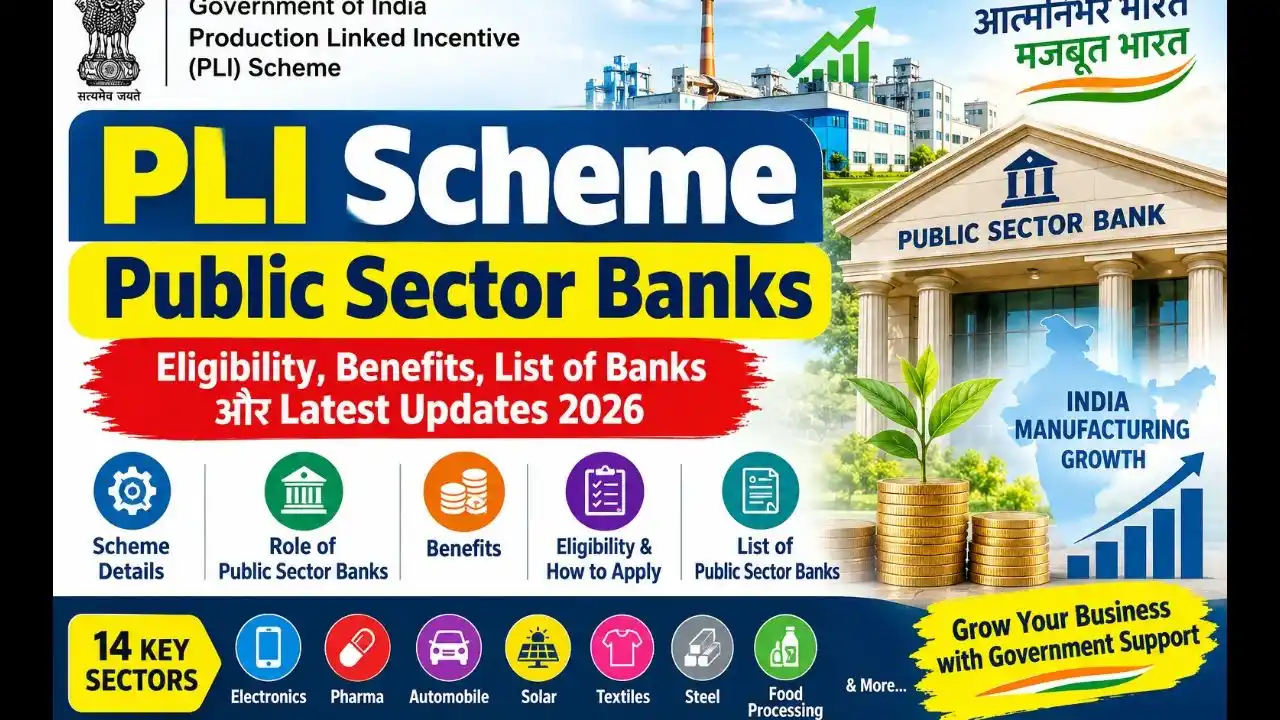
The PLI Scheme Public Sector Banks is a search term used by people looking for information about the Production Linked Incentive (PLI) Scheme and the role of public sector banks in supporting businesses in India. The PLI Scheme is a Government of India initiative designed to encourage domestic manufacturing, attract investment, increase exports and generate employment.
Public sector banks play an important role in financing eligible businesses, supporting industrial expansion and providing banking services to companies participating in manufacturing-related schemes. However, the PLI Scheme is not a general subsidy scheme for public sector banks themselves. It is primarily intended for eligible manufacturers and businesses operating in specified sectors.
In this article, we will explain the PLI Scheme, its objectives, the role of public sector banks, the major sectors covered, eligibility requirements, benefits and how businesses can find the relevant official information.
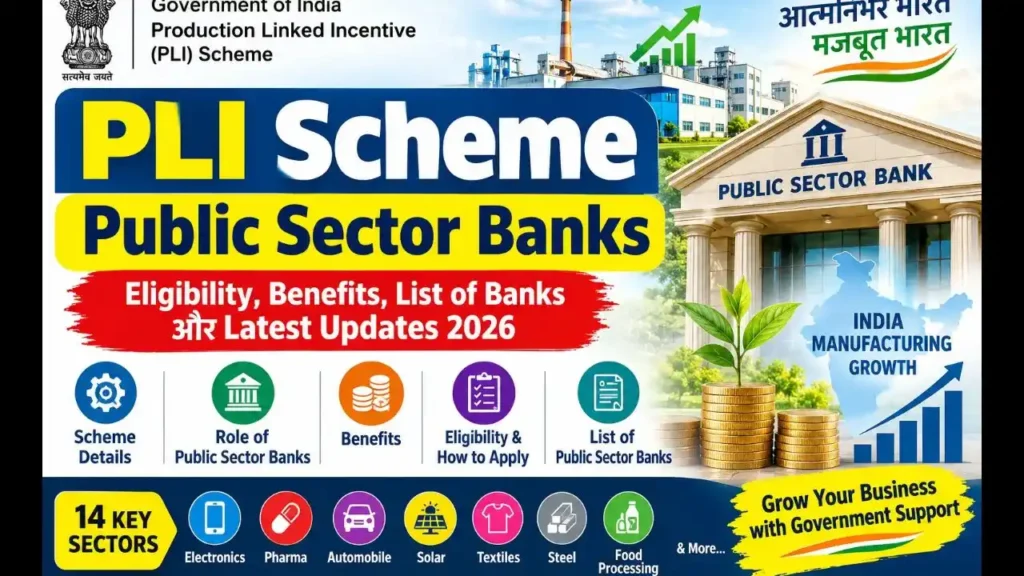
PLI Scheme 2026: Overview
The Production Linked Incentive Scheme was introduced to strengthen India’s domestic manufacturing capacity and improve the competitiveness of Indian industries. The government announced PLI schemes covering 14 key sectors, with an original approved financial outlay of approximately ₹1.97 lakh crore.
According to the Press Information Bureau, as of 31 December 2025, the PLI schemes had attracted investments exceeding ₹2.16 lakh crore, supported production and sales exceeding ₹20.41 lakh crore, and generated over 14.39 lakh direct and indirect employment opportunities. These figures demonstrate the scale of the initiative.
| Scheme detail | Information |
|---|---|
| Full form | Production Linked Incentive |
| Common abbreviation | PLI Scheme |
| Government initiative | Government of India |
| Main objective | Increase domestic manufacturing |
| Coverage | 14 key manufacturing sectors |
| Original announced outlay | Approximately ₹1.97 lakh crore |
| Main beneficiaries | Eligible manufacturers and companies |
| Role of public sector banks | Financing and banking support |
| Official information | PLI Scheme portal |
What Is the PLI Scheme?
The Production Linked Incentive Scheme is a government incentive programme that rewards eligible companies for achieving specified production or sales-related conditions under their respective schemes.
Unlike a general business loan, a PLI incentive is not simply money borrowed from a bank. Eligible companies must satisfy the applicable scheme guidelines, investment requirements, production targets and other conditions before receiving an incentive.
For example, imagine an Indian company manufacturing electronic components. If the company meets the applicable investment, production and other eligibility requirements under the relevant PLI scheme, it may qualify for incentives calculated according to that scheme’s rules.
The programme aims to encourage companies to expand production in India, improve manufacturing efficiency, develop domestic supply chains and reduce dependence on imports in selected industries.
What Is the Role of Public Sector Banks in the PLI Scheme?
Public sector banks are government-owned banking institutions that provide financial services to individuals, businesses and industries.
In the context of the PLI Scheme, their role is mainly indirect. They can support eligible manufacturing businesses through loans, working capital, equipment financing, payment services and other financial products, subject to their lending policies.
The PLI incentive itself is administered through the relevant government ministry or department. A public sector bank does not automatically become a PLI beneficiary merely because it is a government-owned bank.
1. Business Loans for Manufacturing Companies
Manufacturers may require funding to purchase machinery, establish factories, expand production facilities or upgrade existing equipment.
Public sector banks may evaluate loan applications from these companies based on their financial position, business plan, repayment capacity, security requirements and applicable lending policies.
2. Working Capital Finance
Manufacturing companies often need money to purchase raw materials, pay employees, maintain inventory and meet operating expenses.
Banks may provide working capital facilities to eligible businesses, helping them manage their day-to-day financial requirements.
3. Equipment and Machinery Financing
Businesses expanding their production capacity may require loans to purchase specialised equipment or modern manufacturing technology.
The availability and terms of financing depend on the bank’s assessment of the business and the relevant loan product.
4. Export and Trade Finance
Companies participating in manufacturing supply chains may also need assistance with international trade, export transactions, letters of credit and other trade-related banking services.
Public sector banks can provide suitable facilities to eligible businesses according to their policies and regulatory requirements.
5. Banking and Payment Services
Banks also support manufacturers through current accounts, digital payment facilities, salary payments, tax payments and other transaction services.
These services help businesses manage their operations while meeting the financial and reporting requirements applicable to them.
Major Sectors Covered Under the PLI Scheme
The PLI initiative covers 14 major sectors. Each sector has its own guidelines, eligible products, conditions and incentive structure.
| No. | Sector | Example of eligible industry activity |
|---|---|---|
| 1 | Large-scale electronics manufacturing | Mobile phones and specified electronic components |
| 2 | IT hardware | Laptops, tablets and other specified equipment |
| 3 | Pharmaceuticals | Eligible pharmaceutical products |
| 4 | Bulk drugs | Specified pharmaceutical ingredients |
| 5 | Medical devices | Eligible medical equipment |
| 6 | Automobiles and auto components | Eligible vehicles and automotive components |
| 7 | Advanced Chemistry Cell batteries | Specified battery manufacturing |
| 8 | Solar PV modules | High-efficiency solar module manufacturing |
| 9 | Telecom and networking products | Eligible telecom equipment |
| 10 | Food processing | Specified processed food products |
| 11 | Textiles | Eligible textile products |
| 12 | Specialty steel | Specified high-value steel products |
| 13 | White goods | Air conditioners and LED products |
| 14 | Drones and drone components | Eligible drones and related components |
The sectors and their specific coverage are described in government publications on PLI. See the official PLI information.
Who Is Eligible for the PLI Scheme?
Eligibility depends on the particular sector and its applicable scheme guidelines. Not every business or company automatically qualifies for incentives.
Potential applicants should check the following requirements before applying.
1. Business and Company Requirements
The applicant must meet the legal entity and business requirements specified under the relevant scheme. Some schemes may target particular categories of manufacturers or companies.
2. Eligible Products
The products manufactured by the applicant must fall within the scheme’s specified product categories.
A company manufacturing products outside the approved scope may not qualify, even if it operates in a broadly related industry.
3. Investment Conditions
Certain PLI schemes specify minimum investment requirements or other investment-related conditions. Applicants should check the relevant guidelines for the required amount and assessment period.
4. Production and Sales Requirements
Some schemes calculate incentives using eligible incremental sales or other production-related performance measures. The applicable calculation method varies by scheme.
5. Documentation and Compliance
Applicants may need to provide incorporation documents, financial statements, investment details, production information, sales records and other supporting documents.
The precise document list must be checked in the relevant scheme guidelines.
How to Apply for the PLI Scheme in 2026
There is no single application process that applies identically to every PLI sector. The relevant ministry, department or implementing agency manages the applicable process.
Follow these general steps.
Step 1: Visit the official portal
Open the PLI Scheme portal to find relevant scheme information and available guidelines.
Step 2: Identify your sector
Determine whether your business operates in electronics, pharmaceuticals, textiles, food processing, automotive manufacturing or another covered sector.
Step 3: Read the scheme guidelines
Check eligibility, eligible products, investment conditions, performance criteria, application deadlines and the implementing agency’s instructions.
Step 4: Check the application window
Some schemes accept applications during specified periods or through particular application rounds. Do not assume that applications are currently open.
Step 5: Prepare the required documents
Collect the documents requested by the relevant scheme, including business registration details, financial information, investment records and production-related information where applicable.
Step 6: Submit the application
Complete the application using the official procedure specified for the relevant scheme. Keep the acknowledgement and application reference for future communication.
Step 7: Monitor the application
Follow the implementing agency’s instructions for application status, clarification requests, approval and incentive claims.
Step 8: Contact a bank if financing is required
If the project requires additional funding, approach a public sector bank or another suitable lender separately. Approval of a bank loan and approval for a PLI incentive are different decisions.
Documents Required for a PLI Application
The exact requirements vary by sector, but applicants may be asked for documents such as:
- Company incorporation or business registration documents.
- PAN and applicable tax registration details.
- Audited financial statements.
- Details of directors or authorised representatives.
- Investment and machinery purchase records.
- Manufacturing facility and production information.
- Eligible product details and sales records.
- Bank account information and supporting declarations.
- Any additional certificates required under the relevant scheme.
This is an indicative checklist, not a universal mandatory document list. Always use the official checklist for your specific PLI scheme.
Benefits of the PLI Scheme for Businesses
Encourages Manufacturing Expansion
The scheme encourages eligible businesses to increase production capacity and invest in manufacturing operations in India.
Supports Investment
Performance-linked incentives may improve the financial attractiveness of eligible manufacturing projects, although the final benefit depends on scheme conditions and business performance.
Creates Employment Opportunities
Expansion in manufacturing can create direct jobs in factories and indirect employment in logistics, supply chains, maintenance and related services.
Strengthens Domestic Supply Chains
The programme aims to improve India’s manufacturing ecosystem and encourage domestic production of selected goods and components.
Improves Export Potential
Eligible manufacturers may become more competitive in domestic and international markets through expanded capacity, improved efficiency and technological investment.
Supports Access to Finance
Businesses may also explore suitable loans and other financial services from public sector banks. Such financing is separate from the government incentive and remains subject to the lender’s assessment.
Difference Between the PLI Scheme and a Public Sector Bank Loan
| Feature | PLI Scheme | Public sector bank loan |
|---|---|---|
| Main purpose | Encourage eligible production | Provide finance |
| Source | Government incentive programme | Bank lending |
| Repayment | Generally not a loan repayment obligation; scheme conditions apply | Repayment with applicable interest and charges |
| Eligibility | Scheme-specific criteria | Bank-specific credit criteria |
| Amount | Determined by the relevant scheme | Determined by the lender and approved facility |
| Approval authority | Relevant government implementing agency | Lending bank |
| Availability | Depends on the scheme and its application rules | Depends on the bank’s products and lending decision |
A business may explore both options, but it should never assume that receiving a bank loan guarantees PLI approval or that PLI approval guarantees a bank loan.
Latest PLI Scheme Updates in 2026
Government figures published in March 2026 reported that, as of 31 December 2025, the PLI schemes had attracted more than ₹2.16 lakh crore in investment, generated production and sales exceeding ₹20.41 lakh crore, and supported over 14.39 lakh direct and indirect jobs.
These figures represent cumulative results across the covered schemes, rather than benefits received by every applicant or by public sector banks.
For current application notices, scheme guidelines and sector-specific updates, applicants should consult the official PLI portal and the relevant implementing ministry.
Frequently Asked Questions (FAQs) PLI Scheme
1. What is the full form of PLI?
PLI stands for Production Linked Incentive. It is a government initiative intended to encourage eligible production and manufacturing activities in specified sectors.
2. Is the PLI Scheme available for public sector banks?
The PLI Scheme is primarily designed for eligible manufacturers and companies in covered sectors, not as a general incentive programme for public sector banks. Banks may support participating businesses through financial services.
3. Which public sector banks can provide loans to PLI-related businesses?
Businesses may approach institutions such as SBI, Punjab National Bank, Bank of Baroda, Canara Bank and other public sector banks. Loan approval depends on the bank’s credit assessment and applicable conditions.
4. How many sectors are covered under the PLI Scheme?
The original PLI framework announced coverage of 14 key sectors. Each sector has its own rules and implementation arrangements.
5. How can I apply for the PLI Scheme online?
Visit the official PLI portal, identify the relevant sector, read the applicable guidelines and follow the application process specified by the implementing agency. Application windows may vary.
6. Can small businesses apply for the PLI Scheme?
Eligibility depends on the specific sector and scheme rules. Some PLI schemes have included eligible MSMEs, but small-business status alone does not guarantee approval.
7. Does a PLI applicant need a bank loan?
No. A bank loan is not automatically required for every applicant. Businesses may need financing depending on their project and financial position, while PLI eligibility is determined separately.
8. Is the PLI Scheme a loan or a subsidy?
PLI is a performance-linked government incentive programme, not a conventional bank loan. Incentives are provided according to the applicable scheme’s conditions.
9. Where can I check the latest PLI Scheme notification?
Check the official PLI portal and the website of the ministry or department responsible for the relevant sector. These sources provide scheme-specific notices and guidelines.
10. Does every public sector bank distribute PLI incentives?
No. Public sector banks should not be assumed to be authorised PLI incentive-disbursing institutions. Follow the relevant scheme’s official instructions for incentive claims and payments.
Conclusion
The PLI Scheme Public Sector Banks topic connects two important parts of India’s economic development: government support for manufacturing and banking support for businesses.
The Production Linked Incentive Scheme encourages eligible manufacturers to expand production, attract investment, create employment and improve India’s competitiveness. Public sector banks can contribute by offering suitable business loans, working capital facilities, equipment finance and other banking services to eligible companies.
However, PLI incentives and bank loans are separate. Before applying, businesses should verify their sector’s eligibility criteria, application window, required documents and incentive calculation method through official government sources.
For the most accurate information, visit the official PLI Scheme portal and contact a suitable public sector bank if your manufacturing project requires financing.
Also read:-

Dharitri Assam is an Assam-focused information platform providing the latest updates on government jobs, education, schemes, scholarships, admit cards, results, and career opportunities. Our goal is to make useful and reliable information easy to understand and accessible to everyone in Assam.